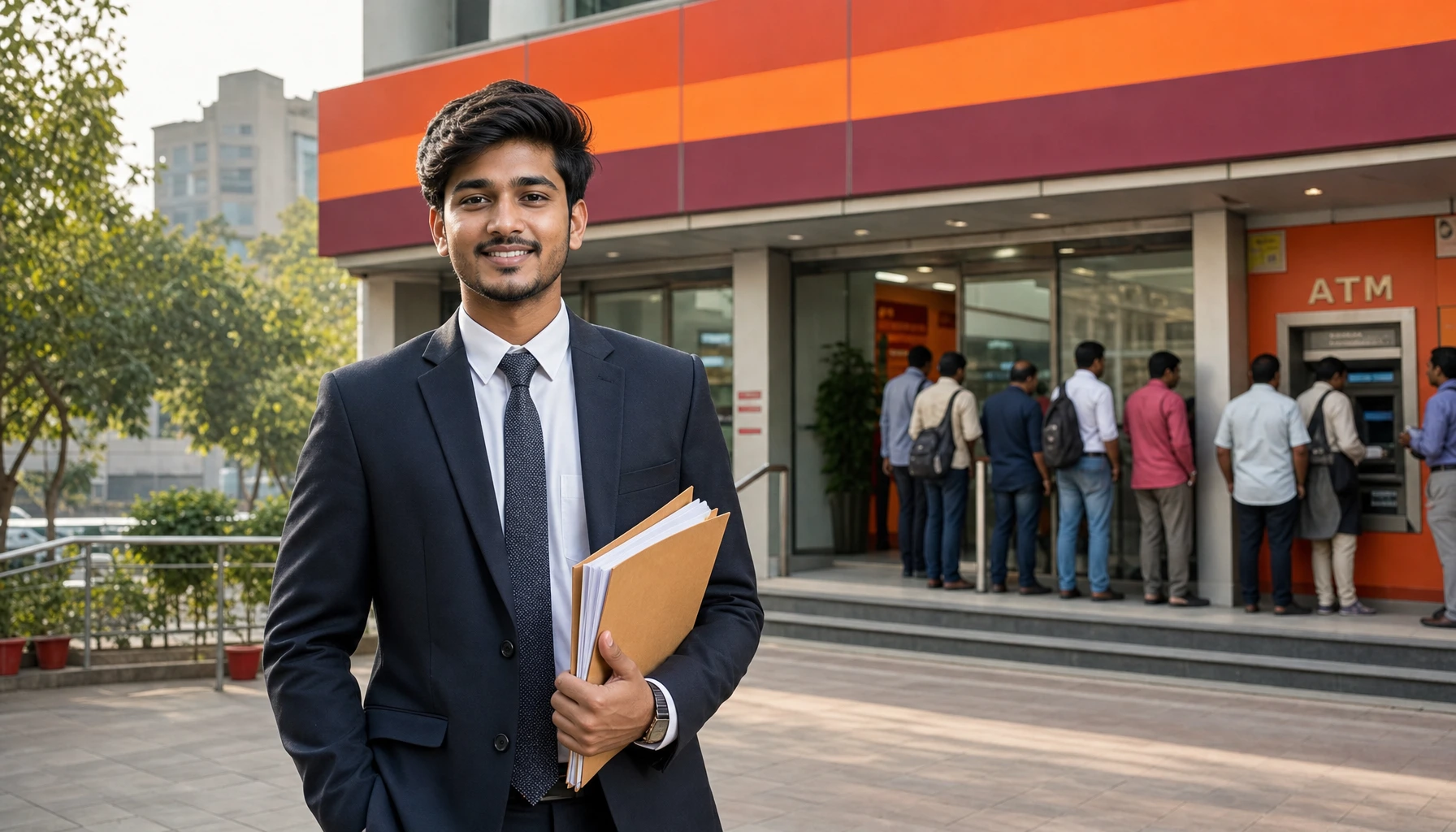
Bank of Baroda has opened applications for one of the largest apprenticeship drives in the Indian banking sector this year. The bank is engaging 5,000 apprentices under the Apprentices Act, 1961, with online registration running from 19 May 2026 to 8 June 2026.CSIR ASO 2026
If you’re a graduate looking for a structured one-year stint inside India’s second-largest public sector bank — with a monthly stipend and a recognised completion certificate — here’s everything worth knowing before you apply.
Notification reference: BOB/HRM/APPRENTICE/ADVT/2026/01
Quick Snapshot
| Item | Detail |
|---|---|
| Total seats | 5,000 |
| Registration opens | 19 May 2026 |
| Last date to apply | 8 June 2026 |
| Cut-off date for eligibility | 1 May 2026 |
| Training duration | 12 months (on-the-job) |
| Monthly stipend | ₹15,000 |
| Age | 20–28 years (relaxations apply) |
| Qualification | Graduation in any discipline |
Who Can Apply
The criteria are deliberately broad to attract fresh graduates from across the country.
Age: Minimum 20, maximum 28 years as on 1 May 2026. SC/ST candidates get a 5-year relaxation, OBC (non-creamy layer) get 3 years, and PwBD candidates get 10–15 years depending on category. The notification clarifies that NAPS-registered candidates must still be under 34 on the cut-off date.
Education: A graduation degree in any discipline from a recognised university. If you’re applying via the NATS portal, your graduation must have been completed within four years preceding 1 May 2026.SSC 2026
Registration: Before you can apply on the BFSI SSC portal, you must first register on either the NAPS portal (apprenticeshipindia.gov.in) or the NATS portal (nats.education.gov.in). This is a hard prerequisite — no exceptions.
There are also a few disqualifying conditions worth flagging:
- You should not have undergone apprenticeship with Bank of Baroda or any other establishment in the past.
- You should not currently be pursuing apprenticeship anywhere else.
- If you have one year or more of training or job experience after completing your graduation, you’re not eligible.
- Ex-servicemen are not eligible for apprentice engagement.
How the 5,000 Seats Are Distributed
The bank has spread vacancies across all 35 states and union territories, but the distribution heavily favours states where Bank of Baroda has a strong branch network. Gujarat tops the list with 960 seats (its home state, predictably), followed by Uttar Pradesh with 764, Maharashtra with 580, Karnataka with 483, and Rajasthan with 412. Smaller allocations — sometimes a single seat — go to states like Manipur, Sikkim, and the Andaman & Nicobar Islands.AEE Recruitment 2026
A few high-volume states to keep in mind:
- Andhra Pradesh: 188 seats
- Bihar: 179 seats
- Tamil Nadu: 199 seats
- West Bengal: 194 seats
- Madhya Pradesh: 136 seats
- Kerala: 111 seats
- Chhattisgarh: 122 seats
You can apply for only one state or UT, and within that you can list up to three preferred training centres. Allocation is by merit, your preferences, and seat availability — and the bank reserves the right to place you at any centre within your chosen state if your preferred ones are full. Once you pick a state, that decision is final; you cannot request transfer to another state later.
Reservations follow the standard pattern: SC, ST, OBC, and EWS quotas apply, with PwBD reservation as a horizontal slice across all categories.
Selection Process
Selection happens in three stages.
1. Online Examination. A 60-minute objective test with 100 questions across four sections: General/Financial Awareness, Quantitative & Reasoning Aptitude, Computer Knowledge, and General English. Each section carries 25 marks. The first three sections are available in Hindi or English; the English section is, naturally, English only. There is no negative marking, which is unusual for banking exams and worth taking advantage of.
The exam is remotely proctored — you take it from home (or wherever you have a quiet space) on a smartphone, laptop, desktop, or tablet with a working front camera, microphone, and stable Wi-Fi. No need to travel to a test centre for this stage.
2. Document Verification. Candidates who clear the online exam are called to a centre in their chosen state to verify their original documents. You pay your own travel costs — the bank does not reimburse anything.
3. Local Language Proficiency Test. This is the stage many candidates underestimate. You must be able to read, write, speak, and understand one of the specified local languages of your applied state. For Andhra Pradesh, for example, the language is Telugu or Urdu. For Maharashtra, it’s Marathi. For Tamil Nadu, Tamil. The full mapping is in the notification.
There’s an important exemption: if you studied the specified local language as a subject in 10th or 12th standard and can produce the mark sheet, you don’t need to sit for this test. Otherwise, failing this test disqualifies you regardless of how well you did on the online exam.
Merit lists are drawn state-wise and category-wise. Tie-breaker is age, with the older candidate ranked higher.
Application Fees
Fees are paid online to BFSI SSC and are non-refundable.
| Category | Fee (plus GST) |
|---|---|
| SC / ST | ₹200 |
| PwBD | ₹200 |
| General, EWS, OBC — Male | ₹800 |
| General, EWS, OBC — Female / Transgender | ₹600 |
What the Apprenticeship Actually Looks Like
A few things are worth being clear-eyed about before you apply.
This is not a job. The notification repeats this in several places: apprentices are trainees, not employees. You don’t get the benefits regular or contractual Bank of Baroda staff receive. You have no right to claim employment after the training ends, and the bank has no obligation to offer you one. After 12 months, you’re relieved.
The stipend is ₹15,000 per month, paid at the end of each month, with deductions for any loss of pay. That’s it — no allowances, no transport, no hostel, no residential accommodation. You arrange your own stay near your training centre.
You’ll get a certificate. At the end of the year, you sit for a final assessment, and based on your marks an Apprenticeship Certificate is issued. For many graduates, this is the real value: a recognised credential, a year inside a major PSU bank’s operations, and a CV line that opens doors to banking sector recruitment exams (IBPS, SBI, RBI) and private sector roles.
You cannot join or form a union. The notification is explicit about this.
How to Apply: The Step-by-Step
- Register on NAPS or NATS (or both) — apprenticeshipindia.gov.in and/or nats.education.gov.in. Keep your Enrolment ID (NATS) and Apprentice Registration Code (NAPS) safe; you’ll need them throughout the program.
- Keep these documents ready as JPEG or PDF, each under 1 MB: Aadhaar (front and back), PAN, passport-size photo, signature, 10th and 12th mark sheets, degree mark sheet or provisional certificate, and a bank passbook or cheque leaf.
- Search “Bank of Baroda” on the apprenticeship opportunity section of either portal and apply against the advertised vacancy.
- Wait for the email from info@bfsissc.com — this is the trigger to fill the final Application cum Examination Form, where you select your state, preferred centres, category, PwBD status, and pay the fee.
- Pay the fee online through the secure link in the form. Your registration is only complete once payment is confirmed.
- Save your acknowledgement number and take a printout of your application.
Keep your registered email and mobile active throughout — every communication (exam date, document verification, language test) goes there. No hard copy intimation letters are sent by post.
A Few Things Easy to Miss
- Apply early. Server load close to the deadline is a real issue. The bank explicitly states it won’t take responsibility for last-day failures.
- Submit only one application. Multiple applications mean only the last one counts, and earlier fees are forfeited. Appearing multiple times in the exam leads to summary rejection.
- Category cannot be changed after submission. Decide carefully.
- OBC certificate must include the non-creamy-layer clause and be issued within one year of the advertisement date. The caste name must match the Central Government list letter by letter.
- EWS certificate must be on the prescribed Income and Asset Certificate format for the relevant financial year.
- A wait-list is published and remains valid for one year from result declaration or until the next engagement cycle, whichever comes first.
Where to Track Updates
All corrigenda, exam dates, and result announcements appear on:
- Bank of Baroda’s career page: bankofbaroda.bank.in → Current Opportunities
- BFSI SSC: bfsissc.com
No separate communication is sent to candidates who aren’t shortlisted — anything posted on these sites counts as official intimation.
Bottom Line
For a 2024 or 2025 graduate sitting at home preparing for banking exams, this is a relatively low-friction route to a year of real banking exposure and a stipend that covers basic expenses in most cities. It’s not a permanent job, and the bank goes out of its way to remind you of that. But for the CV, the certificate, the structured learning, and the network you’ll build inside the BoB ecosystem, the 12 months can be a useful bridge between graduation and your eventual full-time role.
The application window is short — 20 days from 19 May to 8 June 2026. Register on NAPS or NATS this week, get your documents scanned, and apply early.
All details are sourced from the official advertisement BOB/HRM/APPRENTICE/ADVT/2026/01 dated 19 May 2026, issued by the Chief General Manager (HRM & Marketing), Bank of Baroda, Mumbai.